Septa
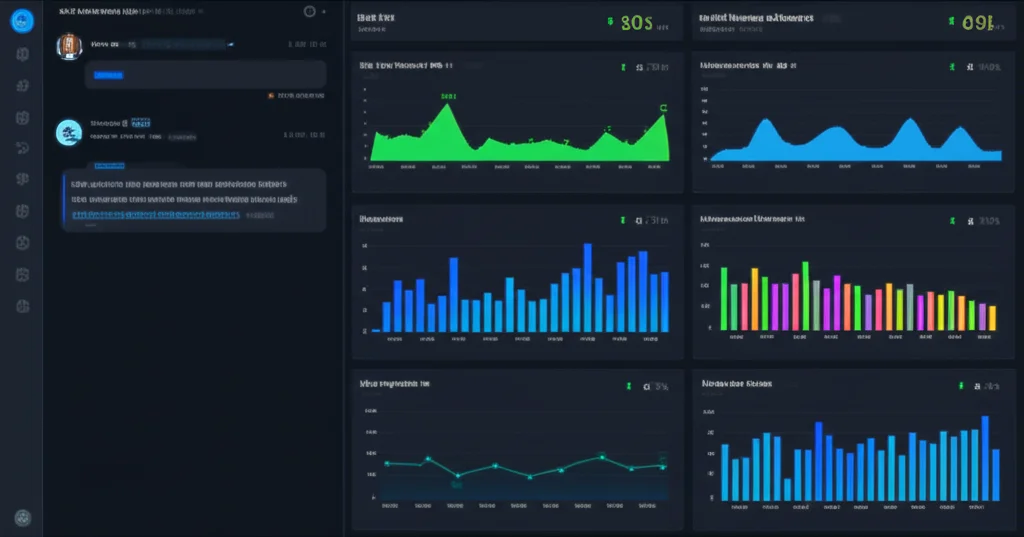
Your GenAI-Powered Data Analyst
Your generative AI-powered data analyst — on-premise AI that transforms natural language into data-driven insights
Query Accuracy
Faster Processing
Data Points Analyzed
Deployment Time
Query Accuracy
Faster Processing
Data Points Analyzed
Deployment Time
Key Capabilities
Intelligence
Natural Language Querying
Ask questions in plain English — Septa generates optimized SQL, validates results, and presents visual answers with confidence scores.
Automated Anomaly Detection
Continuous monitoring surfaces data anomalies before they become business problems, with root-cause analysis and alert routing.
Explainable AI
Every insight comes with a confidence score, data lineage trace, and plain-language explanation of how the answer was derived.
Integration
Multi-Source Integration
Connect to BigQuery, Snowflake, PostgreSQL, MongoDB, SAP, Salesforce, and 20+ other data sources with zero-ETL connectors.
On-Premise Deployment
Full air-gapped deployment for data sovereignty. Your data never leaves your infrastructure — models run entirely on-premise.
Security
Enterprise Security
Role-based access controls, row-level security, audit logging, and encryption at rest and in transit. SOC 2 and ISO 27001 compliant.
Use Cases by Industry
See how Septa delivers value across verticals.
Regulatory Reporting
Automated RBI compliance reports generated from natural language queries
Risk Analytics
Real-time portfolio risk assessment with conversational exploration
Customer 360
Unified view across accounts, transactions, and interactions via natural language
Traditional BI Tools vs Septa
| Dimension | Traditional BI | Septa-Powered |
|---|---|---|
| Query Method | SQL / drag-and-drop | Natural language |
| Time to Insight | Hours to days | Seconds |
| Technical Skill Required | SQL + BI tool expertise | None — conversational |
| Dashboard Setup | Weeks of development | Auto-generated from questions |
| Anomaly Detection | Manual threshold alerts | AI-powered, continuous |
| Data Lineage | Separate governance tool | Built-in with every query |
| Deployment | Cloud-only (most vendors) | Cloud, on-premise, air-gapped |
Integration Ecosystem
Seamless connectivity with the platforms you already use.
What Clients Say
“Liberin's AI solutions transformed our claims processing. What took days now takes minutes, with 92% accuracy in automated categorization.”
CTO
Leading Insurance Provider
Case Studies

AI-Powered Claims Processing
Manual claims processing required 5-7 business days per claim with high error rates and inconsistent decisions across adjusters.
Faster Processing
Accuracy

Real-Time Quality Inspection
Quality inspection across 12 production lines relied on manual sampling, catching only 60% of defects before shipment.
Defect Detection
Fewer Returns

Predictive Maintenance Analytics
Unplanned equipment downtime cost $2.3M annually, with reactive maintenance unable to prevent cascading failures.
Advance Warning
Less Downtime
Related Services
Agentic AI
Build autonomous AI agents that reason, plan, and execute multi-step workflows.
Enterprise RAG
Build retrieval-augmented generation systems grounded in your proprietary data.
Legacy-to-Agentic
Transform legacy applications into AI-powered agentic systems.
SLM Training
Train small language models for on-device and edge deployment.
LLM Training
Train and fine-tune large language models for enterprise use.
Context Engineering
Design context systems that make AI reliable in production.
Frequently Asked Questions
What is Septa and how does it differ from traditional BI tools?
Septa is a GenAI-powered analytics platform that lets users query data in natural language instead of writing SQL. Unlike traditional BI tools that require technical expertise and weeks of dashboard setup, Septa delivers instant insights through conversational interfaces with automated visualization and anomaly detection.
What data sources does Septa integrate with?
Septa connects to all major data warehouses (BigQuery, Snowflake, Redshift), relational databases (PostgreSQL, MySQL, SQL Server), NoSQL databases (MongoDB, DynamoDB), cloud storage (S3, GCS), and enterprise platforms (SAP, Salesforce). Custom connectors are available for proprietary data sources.
How does Septa ensure accuracy in AI-generated analytics?
Septa uses a multi-layer validation pipeline: semantic parsing validates query intent, generated SQL is syntax-checked and optimized, results are cross-verified against known benchmarks, and confidence scores are provided with every response. Our enterprise RAG architecture grounds responses in your actual data, reducing hallucinations by 80%.
Can Septa handle sensitive or regulated data?
Yes. Septa supports on-premise and private cloud deployment, role-based access controls, data masking, audit logging, and encryption at rest and in transit. It is designed to meet ISO 27001, SOC 2, and DPDP Act compliance requirements.
What is the typical deployment timeline for Septa?
A standard Septa deployment takes 4-8 weeks depending on data complexity: Week 1-2 for data source integration and schema mapping, Week 3-4 for semantic layer configuration and model fine-tuning, Week 5-6 for user acceptance testing, and Week 7-8 for production rollout and training.

Let'sBuildSomethingExtraordinary
Have a project in mind? We'd love to discuss how our expertise can bring your vision to life.